
Brief
Recurrent congestion on the Wellington motorway network called for an active traffic-management response. The result was New Zealand’s first Smart Motorway — a combination of intelligent transport systems managing speeds in real time.
What we did
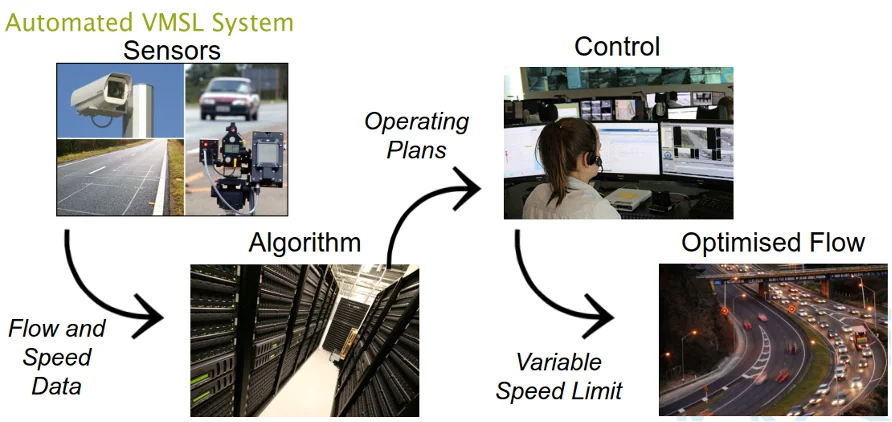
TTAP’s Bob Hu — as Lead ITS Analyst for the NZ Transport Agency in 2016, before founding TTAP — designed the algorithms behind the Variable Mandatory Speed Limits (VMSL) that manage congestion on the network. The VMSL regime is driven by a Model Predictive Control (MPC) framework Bob developed: a predictive software module that sits inside NZTA’s standard sensor-data system, reads live detector data, predicts conditions ahead, and triggers the operating system to set the speed regime accordingly. Bob also built the real-time simulation model (METANET) behind it, and designed and tested the integration of ramp metering with VMSL.
The approach was new to New Zealand and globally innovative in how it triggered the speed regime — presented as “NZ’s First Smart Motorway” at the 2016 World Congress on Intelligent Transport Systems.
Outcome
A working, predictive VMSL control system for the Wellington motorway — and the depth of ITS design experience that TTAP brings to intelligent transport systems work today.